


Information Architects, Document Architects, Content Architects and Intelligent Content Architects
Oct 31, 2017
We hear about various types of architects today — information architects, document architects, content architects, solution architects, and so on. This prompted me to look into the definition of these words.
Architect: My son, who is studying Greek at his high school, tells me that it comes from “arche” in Greek, meaning beginning. The Online Etymology Dictionary shows it originates from Greek arkhitekton.
architect (n.) “person skilled in the art of building, one who plans and designs buildings and supervises their construction,” 1560s, from Middle French architecte, from Latin architectus, from Greek arkhitekton “master builder, director of works,” from arkhi- “chief” (see archon) + tekton “builder, carpenter,” from PIE root *teks- “to weave,” also “to fabricate.”
Information Architect
A Brief History of Information Architecture cites R.S. Wurman’s precise definition of an information architect as:
- The individual who organizes the patterns inherent in data, making the complex clear.
- The emerging 21st century professional occupation addressing the needs of the age focused upon clarity, human understanding, and the science of the organization of information.
- A person who creates the structure or map of information which allows others to find their personal paths to knowledge.
Document Architect
I like Keith and Heidi’s elaborations of Documentation Architect. A document architect:
- Clarifies the mission and vision for the document, balancing the needs of its sponsoring organization and the needs of its audiences.
- Determines what content and functionality the document will contain.
- Specifies how users will find information in the document by defining its organization, navigation, labeling, and searching systems.
- Maps out how the document will accommodate change and growth over time.
— Keith Schengili-Roberts (aka DITAWriter)
A documentation architect “can build something novel, thought-out, and designed to guide less-experienced creators to assemble a product that will succeed over a period of time.”
— Heidi Waterhouse
According to Sarah O'Keefe, Content Strategy, Scriptorium Publishing Services, Inc.
“The document architect defines and implements document structure. The document architect must identify information types and establish their required structure. For example, a document architect would build a structure for a company’s training manuals.”
Content Architect
Paraphrasing from The Content Architect: An Essential Role for Successful Content Strategy, a content architect:
- Organizes content, recommending the best approach to structure it so it can be re-used in a variety of situations and across channels and devices easily.
- Creates a content model which involves defining topics and metadata, essentially the core structure of each content item, any workflow and governance rules around it, and the business rules required to identify how content is assembled when a customer requests it.
- Defines this structure for the CMS, and often plays a key role in the selection of the best CMS to support the content model.
“An information architect is an individual who works to make information attractive and accessible to an audience. This type of role can include elements of technical writing or written format creation, as well as graphic design and Web development. Generally, information architecture means developing a better presentation for given data through attention to a digital landscape.”
Daniel O'Neil, IA Practice, Information Architecture:
“An information architect is responsible for representing the structure of a digital space in a way that is meaningful and useful for its visitors.”
Chegg’s internship site has a good definition, along with salary inspiration of $62,000 – $92,000 for students :)
“An information architect is someone who structures information. You do this by organizing digital content, like that found on a website or in software, in a way that is easy to understand, process, and navigate.”
Intelligent Content Architect
Before we can define Intelligent Content Architect, let’s define intelligent content.
Ann Rockley and Joe Gollner define Intelligent Content as:
“Intelligent content is content that is structurally rich and semantically categorized, and is therefore automatically discoverable, reusable, reconfigurable and adaptable.”
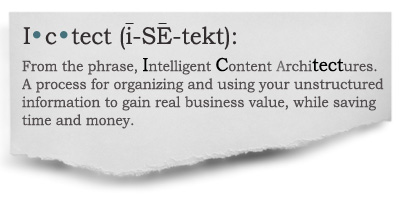
At Ictect, we additionally note that Intelligent Content is content which maximizes the value to the organization while minimizing costs.
So what is an Intelligent Content Architect? He or she sees structure in content which others don’t. An intelligent content architect structures content to maximize benefits to the organization and minimize cost.
Please provide your comments regarding this blog.