


Major Army Prime Contractor Transforms XML Content Development Using Intelligent Content Software from Ictect
SITUATION
A major defense contractor, a leading manufacturer of vehicle systems, faced a growing challenge in managing the complexity and scale of XML-based technical documentation. As the volume of content increased, so did the demand for consistency, accuracy, and speed in XML creation—particularly in alignment with military documentation standards such as MIL-STD-40051.
The existing process relied heavily on manual XML coding by skilled writers. While effective in small batches, this approach introduced several inefficiencies at scale:
Manual XML creation was time-consuming and error-prone.
- Inconsistent formatting and structure led to publishing issues and rework.
- Highly skilled XML authors were spending more time on syntax than on content quality and compliance.
- Late-stage quality checks meant that issues were often discovered too late in the publishing cycle.
This defense contractor needed a solution that would not only streamline XML production but also elevate the role of its content experts—allowing them to focus on quality assurance, compliance, and content integrity.
SOLUTION
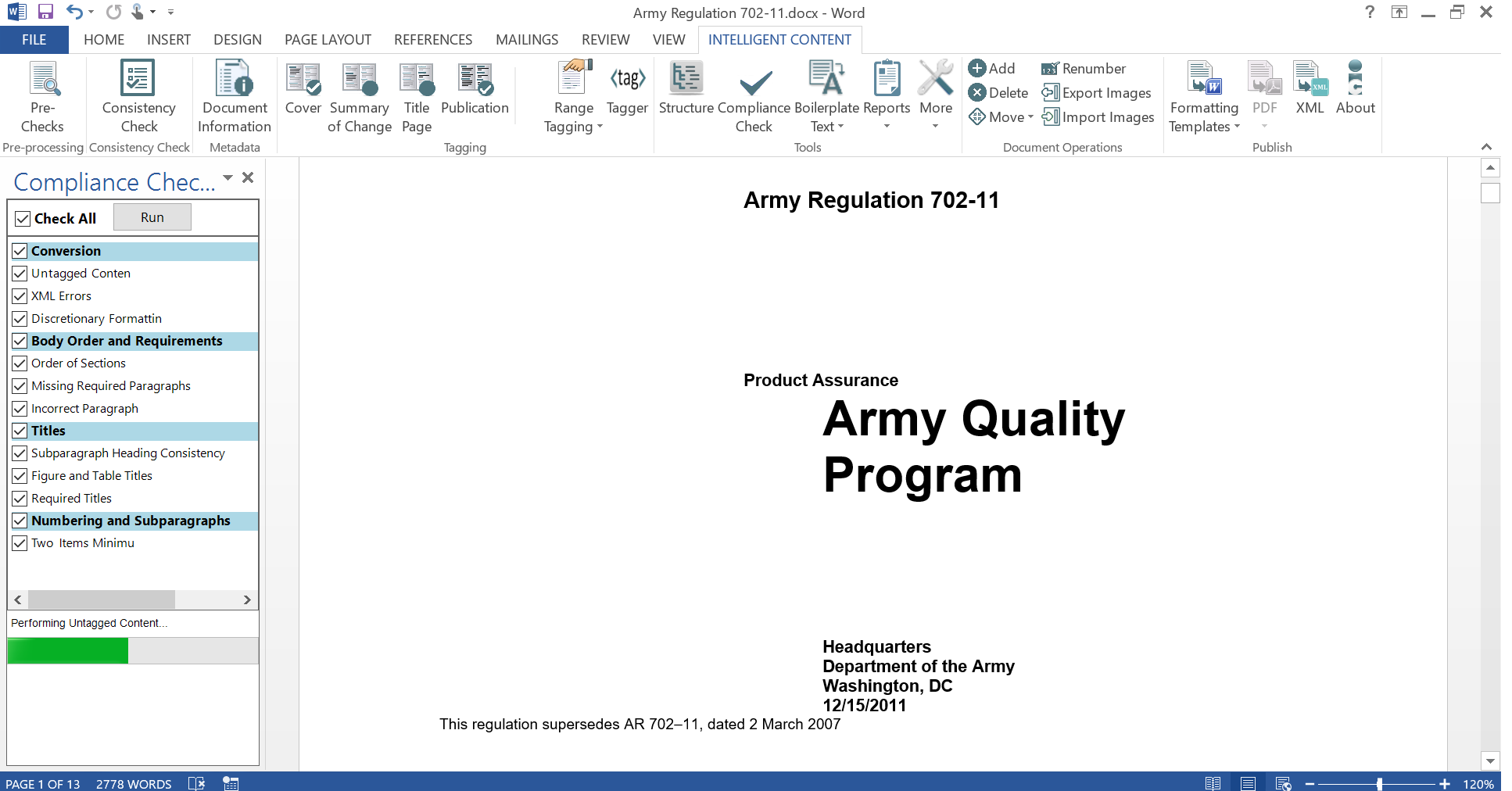
To address these challenges, our team partnered with the defense contractor to implement a structured content solution inspired by Ictect’s Intelligent Content software and the principles of MIL-STD-40051. The core of the solution was the development and deployment of Word-based XML templates—a user-friendly, standards-compliant authoring environment that enabled structured content creation without requiring deep XML expertise.
Key Features of the Solution
- Template-Driven Authoring
We designed Microsoft Word templates that embedded XML structure and logic directly into the authoring environment.These templates guided writers through content creation, ensuring compliance with MIL-STD-40051 while eliminating the need to write raw XML. - Standardization and Repeatability
The templates enforced consistent structure, terminology, and formatting across all documents. This repeatability reduced variability and ensured that all content adhered to the contractor’s documentation standards. - Automation of XML Output
With intelligent tagging and embedded schema rules, the templates automatically generated valid XML behind the scenes. This eliminated manual coding and significantly reduced the risk of syntax errors. - Shift in Authoring Focus
By removing the burden of XML syntax, lead writers were able to focus on content quality, accuracy, and compliance. This shift elevated their role from coders to reviewers and quality assurance leads. - Early Validation and Error Detection
Built-in validation tools allowed writers to catch structural and content issues early in the process—before documents reached the publishing stage. This proactive approach reduced rework and improved overall document quality. - Faster Turnaround and Lower Costs
The streamlined workflow enabled faster content creation and reduced the need for specialized XML developers. This translated into lower production costs and faster delivery timelines.